
Intuitive IT has become a Carbon Positive company
Intuitive IT has become a Carbon Positive company
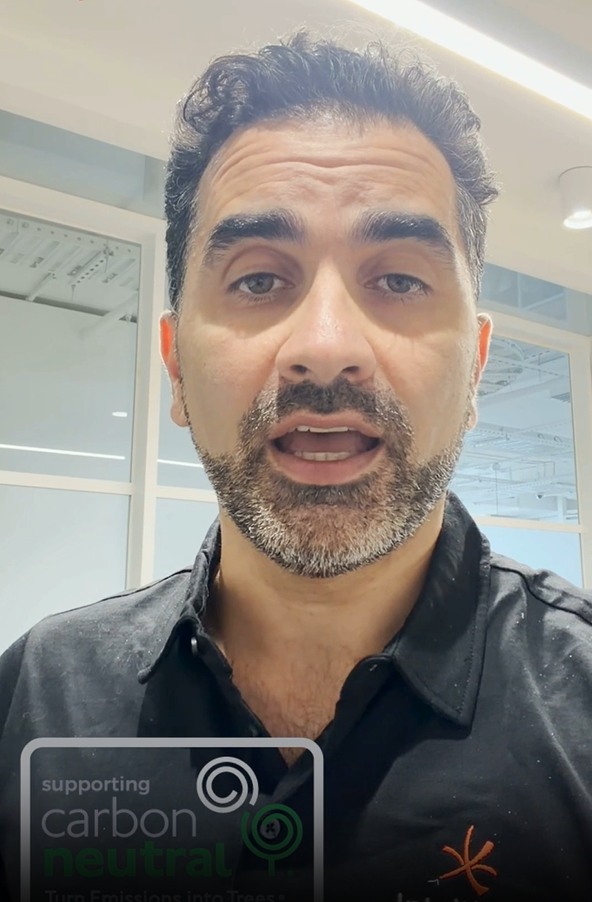
As of December 2025, I’m delighted to say that Intuitive IT is officially carbon-positive. That’s right, not just carbon-neutral, but carbon-positive. We officially started this journey in 2023, when we decided to have our carbon emissions audited by an independent third party.
Since then, with some delays and procrastination, and a lot of head scratching, but mostly procrastination, we finally achieved a carbon positive status. This means, based on our own calculations, that for every tonne of CO2 we emit, we are now removing 6.88 tonnes from the atmosphere.
Why we started
Our journey to become a carbon-positive IT company began before 2023, but there wasn’t much to show for it. As a management team, we discussed our impact on the environment, discussed it a little more, didn’t do anything, discussed it some more, and then decided it was a project for next year. It was always a project for tomorrow.
Our move towards carbon neutrality really picked up speed after a key client, who was also going carbon-neutral, asked us where we stood. That conversation was the spark we needed to ramp up our internal efforts and make our commitment official.
So we started with an audit. We wanted to take a hard, honest look at what we were actually emitting. We reached out to the Rewild agency and commissioned them to provide a report. We wanted to know exactly how many tonnes of CO2 we were emitting each year.
Rewild examined our profit and loss for the 2021-2022 financial year and conducted a series of employee surveys to help calculate our carbon footprint. We were emitting 46.4 tonnes of carbon dioxide per annum.
Of the 46.4 tonnes, 4% were Scope 1 emissions, 12% were Scope 2, and the remaining 84% were Scope 3. Scope 1 was the direct purchase of fossil fuels, which is what we used for the company car. Scope 2 was the electricity used in our offices. Scope 3 was everything else.
At the end of each financial year, we updated our emissions spreadsheet to make sure we were measuring our impact. The emission factors weren’t updated, and most figures were extrapolated from the initial report, but we were confident they were close enough to be useful.
What we did
So the first thing we did was to switch our electricity to Greenpower. This was easy enough to do by calling up our energy provider and making this switch. That reduced our emissions by 12% overnight.
We also started taking better records of vehicle fuel purchases and limiting air travel to only where necessary. In June of 2023, we moved to the Parliament Station Hub coworking space. Hub Australia are carbon neutral and B Corp certified, so that immediately removes our Scope 2 emissions. Having the office in the CBD also meant staff would use more public transport to commute to the office (read: parking is expensive!) and to get to clients in the CBD, which had the added benefit of fewer car-related emissions.
By January 2024, we trialled subsidising public transport for office staff spending three more days in the office. This reduced our emissions by a further 4 tonnes. By this stage, we calculated our total emissions to be 33.05 tonnes—a reduction of 13 tonnes per year.
We then focused on the next most significant emissions: employee energy use while working from home. This contributed 6.1 tonnes or 13% of our overall emissions.
This was a difficult nut to crack because we struggled with exactly how we would measure to then reduce emissions. Do we offset the number of days they work from home? Do we offset only their laptop and the screen emissions? Would they switch to Greenpower for such an amount? What do we do about employees who were already net zero, or at least had solar panels and/or ran off the battery? What do we do with gas heating? We don’t want to offset fossil fuels, as that would inadvertently reward them financially for using gas. We had some brainstorming sessions and reached out to experts, but we couldn’t find an effective way to measure, reduce, and offset these emissions in a fair and balanced way. So our progress stalled.
We switched our attention to becoming carbon-neutral certified. We reached out to the Climate Active department to understand more about their carbon-neutral certification. However, that was a challenging process. We started looking into the requirements for becoming carbon-neutral certified, but we found them unwieldy and in constant flux. We tried to keep up, and we reached the point where we would begin the certification process. It was at that stage that they informed us they had “recently undergone a consultation process” and warned that, within months, the whole certification process would change. It all became too hard.
The global political winds were also shifting. Carbon neutrality was becoming less and less of a political concern. Political will wavered, and with this uncertainty, we put the project on the back burner.
It wasn’t until mid-2025 that we decided to forget certification and simply offset our emissions. We weren’t going to wait for the federal government to get its act together and instead start working toward carbon neutrality, but offsetting.
Eden began the process of finding a program we could invest in. The always sceptical Eden did his research and found someone worthy of our investment. So under his directive, we looked into and approved our carbon-neutral project.
Who we invested in
We wanted to invest in a program that was a gold standard, had been around for a while, and had been shown to reduce emissions. We landed on the program called Improving Domestic Cook Stoves in Malawi. It seemed very niche, but when we read into it, it seemed to have everything we were looking for. The program was regarded as a gold standard in emissions reduction.
It primarily reduces greenhouse gas emissions, but it also provides a range of other benefits. It supports the United Nations Sustainability Development Goals. These cooktops operate efficiently with minimal firewood and use a side-opening design that creates a draft for better combustion. This basic but brilliant innovation slashes greenhouse gas emissions and also indoor pollution. It has the added benefit of reducing health risks like respiratory and eye problems commonly faced by women and children due to smoke exposure. It frees up significant time previously spent gathering wood, allowing them to direct it to more productive activities.
The cooktops are made locally, helping to employ over 300 people. To date, the estimated reduction in emissions is 365,000 tonnes of carbon dioxide. We had found our program.
We purchased 230 tonnes of offsets, which is almost seven times the number of tonnes we emit annually. It was a proud moment for us, and I only wish we’d done this sooner. Powered by the discovery of this program and a fair bit of guilt for sitting on this for so long, we’re more than happy to invest so heavily.
With our newfound sense of achievement, our desire to move to Net Zero has been renewed.
What we are doing next
So we’ve achieved carbon neutrality, and we are carbon-positive, for that matter. And from my Googling, there are only two other MSPs in Australia that can claim this.
But our path to Net Zero continues. We want to be in a position where we are reducing emissions, not just offsetting. We have a few initiatives we are working on.
Firstly, we’re looking to replace the company car with an EV. This move should save approximately 7 tonnes of CO2 per annum.
On our Business Uber account, we have enforced that all trips must be taken with an EV (or a tuk-tuk??). We will continue to encourage public transport as the primary mode of commuting to work and client sites.
We will encourage and prefer carbon-neutral suppliers and begin reaching out to our existing suppliers to discuss their carbon-neutral goals.
And we’ve restarted our search for a solution to find a formula and implement a process to reduce staff emissions when they work from home. Using AI over a day and a half, with a lot of back-and-forth, I (do I have to say “we” now?) have come up with something workable. I have passed this draft policy and procedure to Rewild, and I have a meeting with them in early January to discuss whether it is actually viable. Update: It’s come back and it we’re now in the process of implementing our new policy. This will reduce our carbon footprint by a further ~9 CO2 p.a.
In addition, we will conduct annual surveys of staff and their work-at-home practices to obtain more accurate data on their emissions.
If we can achieve these initiatives, our carbon footprint should be approximately 23 tonnes, even less if we can get suppliers to focus on their own Net Zero initiatives.
Globally and politically, I don’t know what will happen, but we are trending in the wrong direction, given the turmoil and upheaval we’re seeing worldwide. But I also think, “When did we ever take the lead of these politicians?” Change like this is achieved by individuals and businesses who decided that this is important.
And we’ve decided this is important, so that we will continue on our journey to Net Zero. Not because it’s profitable or mandated, but because it’s the right thing to do.